A couple of decades ago I was taking a class at UNC on survey sampling methods. Topics included designing sampling schemes that were efficient in the statistical and actual cost sense, developing variance estimators based on your sampling scheme, etc.
For example if you want to observe and measure some attribute of classes at public schools in your county, it might be infeasible to send data collectors to all of 15 schools, but the marginal cost of measuring additional classrooms at the same school once you're there is minimal. So, how many schools should you visit and how many class rooms per school given a budget and assumptions on inter and intra school variation?
We had had a group assignment to estimate the average circumference of trees on campus. Our initial plan something like 1) get a map of campus and split it into zones 2) sample zones randomly 3) everyone goes to a few (small) zones and tries to roughly map out the trees there 4) sample again from those trees and physically measure them. This would mean running around campus for at least a few days if we wanted to an honest job. And it was a rainy spring in North Carolina.
However, one of my group mates had a stroke of brilliance and decided to email the grounds department. To our surprise they were able to provide us with a full list of every known tree on campus as well as GIS data with locations. So we were able to do a legitimate simple random sample which was optimally efficient from in terms of both variance and time-in-rain.
In conclusion I'm pro list-of-individual-trees.
Delighted to see my local one in there, with a description reading like it was written by Douglas Adams.
“The Hungry Tree is an otherwise unremarkable specimen of the London plane, which has become known for having partially consumed a nearby park bench.”
I googled it and found that it has a more comprehensive Wikipedia article than some prominent historical figures:
> with a description reading like it was written by Douglas Adams.
No kidding! From the wikipedia page:
> Consideration was given to listing the bench as a protected structure but was decided against as there could then have been a requirement imposed on the council to destroy the tree to protect the bench
When I saw the name of that one, I immediately though of the Kite Eating Tree[1].
Growing up I would see authors listing particular species of trees when describing a scene, and I’d marvel at the idea of someone getting all the references. It seemed so old-timey. But during the pandemic, my wife and I got into plants because it was an outdoor activity. I used an app to identify all the trees in our neighborhood (then we found out our town has a map online of them all). I have my favorite ones I like to go by on walks. In a given area there are really only 10 or 15 species you have to know to cover most of the trees you see. Being aware of these things adds depth to the world as you experience it.
My dumb butt thought it was gonna be a list of every tree in the world, all eight gazillion of them
This is a map of all trees in the Netherlands
https://boomregister.nl/overzichtskaart-van-de-bomen-in-nede...
I loathe these stupid widgets that show a blank map as soon as you zoom out a little (past the 1000m scale in this case). How can you fail so hard at your only job?
Well, there are a lot of trees. If you want you can interpret grey as green as that’s what you would see zoomed out?
That’s cool. My ancestor planted some of them. He was a mayor.
I did a search, there are an estimated 3 trillion trees in the world; somehow that's much fewer than I expected.
Well there was probably a lot more a few hundred years ago.
It's actually the opposite, I think. Because of how industrialized the lumber/paper industries have gotten, stewardship of forests has improved over time. This includes replanting in harvested areas.
It is actually three treellion.
Even nature likes a terrible pun.
tree trillion
Tree fiddy and change.
I'm surprised that the Katamari games include a longer list of physical objects than wikipedia.
The list of animals has dolphins and birds but not humans?
Consistent with this definition of ”animal” - https://en.wiktionary.org/wiki/animal#English:_any_nonhuman_...
It’s Wikipedia. Make the change you want to see in the page.
With respect, that is naive. To demonstrate, create a new account and go ahead and make that change. It will be reverted. Wikipedia is not the democratic free-for-all it once was.
If you do perform that experiment and I am wrong, please come back and let us know.
Wikipedia is and has always been a wiki; reverting bad or controversial edits has always been expected from day one.
Also Wikipedia has developed an editorial line of its own, so it's normal that edits that go against the line will be put in question; if that happens to you, you're expected to collaborate in the talk pages to express your intent for the changes, and possibly get recommendations on how to tweak it so that it sticks.
It also happens that most of contributions by first timers are indistinguishable from vandalism or spam; those are so obvious that an automated bot is able to recognize them and revert them without human supervision, with a very high success rate.
However if those first contributions are genuinely useful to the encyclopedia, such as adding high quality references for an unverified claim, correcting typos, or removing obvious vandalism that slipped through the cracks, it's much more likely that the edits will stay; go ahead and try that experiment and tell us how it went.
> reverting bad or controversial edits has always been expected from day one.
How charming of you to think that the well-meaning contributor is going to happily smile and agree with you when you tell them that their well-meaning contributions are bad.
So far around 90% of my contributions have been accepted without discussion, from various accounts/IPs, also in recent months.
There are plenty of "bad and controversial edits" on Wikipedia, just some are more acceptable than others. Wikipedia is an oligarchy.
I’m here to let you know you are wrong.
I made an anonymous edit to the Wikipedia page of one of Hemingways short stories three years ago, and my edit is still there.
You were lucky that you could edit in the first place. Most anonymous editors are blocked before they make an edit due to shared IPs.
I was responding to this:
>> The list of animals has dolphins and birds but not humans?
> It’s Wikipedia. Make the change you want to see in the page.
Yes, minor changes will not draw negative attention but the days when randos could make major edits like that are long gone.
But try it. Maybe I'm wrong.
I’ve made several edits to wiki-pages without even having an account. A few got reverted, most stayed.
Some pages/topics are more open to changes than others, that much is true.
"It’s Wikipedia. Make the change you want to see in the page."
If it allows you to edit it in the first place or isn't reverted within five minutes.
Start with the "practice" articles that Wikipedia suggests when you begin as an editor. They might be stub articles, or articles with obvious issues, that you are expected to research and improve a little. Then edit articles where you have more domain expertise than the original authors.
They have strict rules, but I’ve had no issues editing articles after my first error. It’s certainly not like posting an answer on Stack Overflow, where you will be downvoted and flamed for a correct-but-suboptimal answer.
Most of the time when I try to edit anything, I get a message telling me I am blocked. I am never blocked because of anything I have done but because my shared IP is. It is not something "anyone can edit" as they claim.
I do not wish to have a named account, because I had to leave one after an admin started stalking me on it. I never wanted my Wikipedia editing to be about me, but about the content.
I suppose it's a matter of perspective which one you find worse: getting flamed for trying to contribute, or just having your contributions erased.
A different list https://en.wikipedia.org/wiki/Oldest_hominids#Humans
The term "animal" refers to non-human creatures.
Not when I use the word. Animals are the big creatures that move around. Guess I'm just a preschooler.
People confuse biological science with language, when they are not the same.
Yes, biologically we are animals (and some people behave like them — joke), but humans have used this term to differentiate us from other creatures.
We are very similar to chimpanzees genetically, and people keep bringing this up but we are very different to them in some ways.
So sad that the Sycamore Gap Tree is listed as "historical" because of those two idiots. I'm glad they're in jail.
Also, why isn't the Whomping Willow in there somewhere? They should create a new sub-category for "Fictional" trees.
The most isolated tree on Earth, 300 years old and in the middle of hundreds of kilometers of barren Sahara, was knocked down by a drunk driver in the 70s:
> new sub-category for "Fictional" trees
You could add it to this section:
https://en.wikipedia.org/wiki/List_of_individual_trees#Mytho...
But this looks more appropriate:
I picked three North American trees arbitrarily, and they were all cut down, one by vandals, one by a protester who sounds a bit crazy, and one by a researcher.
Humans, man.
The Tree of Ténéré was a solitary acacia that was once considered the most isolated tree on Earth. It was a landmark on caravan routes through the Ténéré region of the Sahara Desert in northeast Niger, so well known that it and the Lost Tree to the north are the only trees to be shown on a map at a scale of 1:4,000,000. The tree is estimated to have existed for approximately 300 years until it was knocked down in 1973 by a drunk truck driver.
And then there's the Senator Tree [0], estimated to be more than ten times older (~3500 years), which was "killed when a meth addict started a garbage fire inside the hollow trunk so she could see the crystal meth she was trying to smoke."
I got to see The Senator while it was still living. It didn't strike me as special at the time, now it makes me upset to think something so old died in my lifetime for such a stupid reason.
What I find funny is how the drunk driver was able to hit the only obstacle in sight in the middle of an empty desert.
Might’ve been because of this type of thing:
> Target fixation is an attentional phenomenon observed in humans in which an individual becomes so focused on an observed object (be it a target or hazard) that they inadvertently increase their risk of colliding with the object.
forget 300 year old trees... the Californians cut down sequoia trees that were probably up to 6000 years old. The oldest current one alive is estimated to be only 3200 years old.
On a scale of atrocities humans have committed, I can't really think of anything that is more atrocious than the felling of those sequoias that were at the very least as old as the oldest known human civilization. 6000+ years ... poof gone, turned into beams and furniture for houses. They've been around at least 100 Million years, but almost and possibly will not survive what is the equivalent of 0.173 seconds if you scale the 100M years to one day.
Among all the many atrocities humans have and currently are committing, things like destroying something that took 6000 years to grow seems particularly bad because there is no way to even really restore or save that, like you might be able to restore an at-risk population of animals or even revive an extinct species.
It takes about 150-200 years (we don't really know) for a sequoia to become mature, i.e., fruitful, and then it requires fire to reproduce. Let me repeat that, it absolutely requires fire to reproduce once it as matured following surviving around 175 years of human proximity, not sooner.
For our European community, it seems that the various redwoods and sequoia that were planted in Europe in the 19th century, could be coming into maturity now/soon. They are technically invasive, but at a 175 year maturity cycle, I suspect there's not much you have to worry about.
No wonder the location of the oldest tree on Earth is kept secret...
>On a scale of atrocities humans have committed, I can't really think of anything that is more atrocious than the felling of those sequoias
You sure about? You sure you don't wanna think about that one a little longer? Because I can think of a few from just the last few hundred years
While this is interesting and impressive, I kinda relate more to OP's link of more "normal" trees. Going through the list gives me a feeling how many cool trees there are all over the place.
I've been to the Ancient Bristlecone Pine forest in Inyo County, CA where the Methuselah tree lives. Though I didn't get to see that specific tree because the sun was fast setting and I wasn't prepared to hike around in darkness, I had a pretty amazing experience being the presence of 4000- and 5000-year old trees.
I noticed the "bicycle tree" in Scotland which has encapsulated a bicycle amongst other things as it has grown. It reminded me of a very old graveyard I would play in as a kid. The oldest side was all old trees and one day I noticed one of the trees had a couple of gravestones up in its boughs. I always wondered if these were really lifted up there by the tree and if so whether that's unusual.
I would check here for examples: https://old.reddit.com/r/TreesSuckingOnThings/
Appreciate the old.reddit link! Saved me a couple seconds.
Trees don't grow in a manner which can typically lift things. It's really unusual - and requires either distinct circumstances, or highly technical measurements between gauge pins.
Those gravestones had help getting up there.
> A tree located in an established gay cruising area, noted for its slender trunk which facilitates gay sex.
The mind boggles haha
I can't believe this got past the Wikipedia editors.
"This tree, I tell you, has a slutty little back arch".
Incredible
Why would it have been stopped? I don't see anything non-factual, and I regularly pass by that tree. It is well known and referenced [1].
[1] https://www.theartnewspaper.com/2023/12/07/hampstead-heaths-...
"slender trunk which facilitates gay sex"
You don't see the euphemism?
I don't see it. It's a tree that people have sex on. Gay sex, though from the looks of it the tree would be equally well suited for lesbian or straight sex. Presumably one person lies on their stomach on the trunk while one or more people perform penetrative acts. Where is the euphemism? And what is weird about listing this on wikipedia?
How does this work, practically, since it’s so notorious? Is there a queue of dudes waiting to get access to this “private” tree?
I wonder if it has been ruined by becoming well known.
It is sort of funny—based on the Wikipedia they put up notices to stop people from having sex there, which didn’t work. They should have advertised it instead, maybe, the surest way of ruining something niche is to let everybody know about it.
Wikipedia is not censored.
No, but editors there are quite notorious for lacking a sense of humor. I'm not surprised it's listed, I'm surprised that particular euphemistic description remains.
What’s the euphemism? I think people were literally having sex on it, as described in the article.
I read that and assumed this must be some joke article and/or art stunt. After reading the article and linked sources, I'm still not sure that ain't true.
No it's definitely a real tree and not a joke article...
https://www.vice.com/en/article/cruising-spots-uk-london-201...
It's a pretty notorious tree in London, don't see a reason why it wouldn't be included.
This moves me. It affirms that grown trees have tremendous personality.
One of Wikipedia’s greatest contributions is collecting records like this that wouldn’t appear in a traditional encyclopedia.
I think the term for this is 'miscellany' . See Ben Schott's Original Miscellany, and follow-on books. One stand-out is 'Untimely Deaths of Pop Stars' with columns for recording 'Overdose', 'Defenestration' etc. (Check all that apply.) It also organizes weird units of measure, 50 US state conventions for dashed road lines (great example of graphical chart) and day of the week toasts onboard a ship.
Yeah you can bet the Fuck Tree wouldn't make it into any encyclopedia.
Have you considered that you just aren’t reading the cool encyclopedias?
Fair point. If you've got a connect I am all ears!
My own favourite - the Last Ent of Affric:
TIL: The UK designates "trees of special national interest", and has a "Tree of the Year" competition:
https://en.wikipedia.org/wiki/Tree_of_the_Year_(United_Kingd...
But does the article include a handy list of How to Recognise Different Types of Trees from Quite a Long Way Away?
Adyar banyan tree in Chennai is missing.
Ahhh, that is fantastic tree. I've been there, it's in a really nice quiet place. Huge!
However obscure this page might be, I was there just a few days ago. Clicked on it from this article about a tree that was cut down, and it was apparently a big thing in the UK. https://en.wikipedia.org/wiki/Sycamore_Gap_tree
This was huge news in the UK when it happened. Massive public uproar for an illegal felling. The perpetrators were both jailed: https://www.bbc.co.uk/news/articles/c6295zv9101o
I can understand the outrage. Was there any motivation given for why they cut it down? Just vandalism?
I've been following the story for a while and it has never been adequately explained by mainstream media. Consider this... They drove for over an hour in the middle of the night in foul weather to a remote location to cut down a particular tree. That suggests some preplanning.
Yeah I think so. Attention seeking, maybe something to do with a planning application to live somewhere being rejected too: https://www.bbc.co.uk/news/articles/cn811px4m7mo
Honestly it's my first time looking at the story for a while! I just knew they got jail time for it.
"What are you in for?"
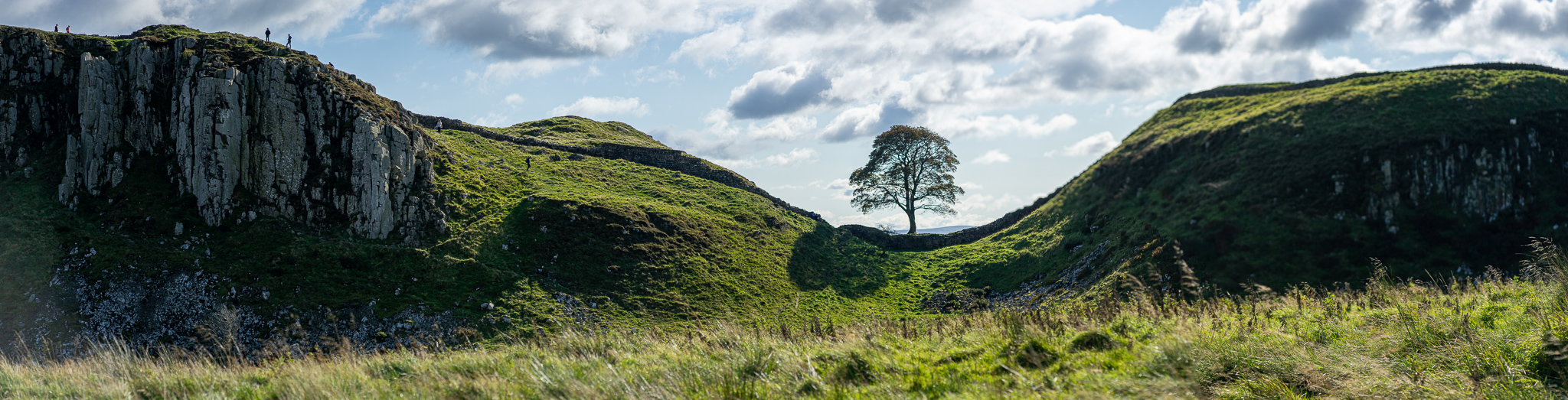
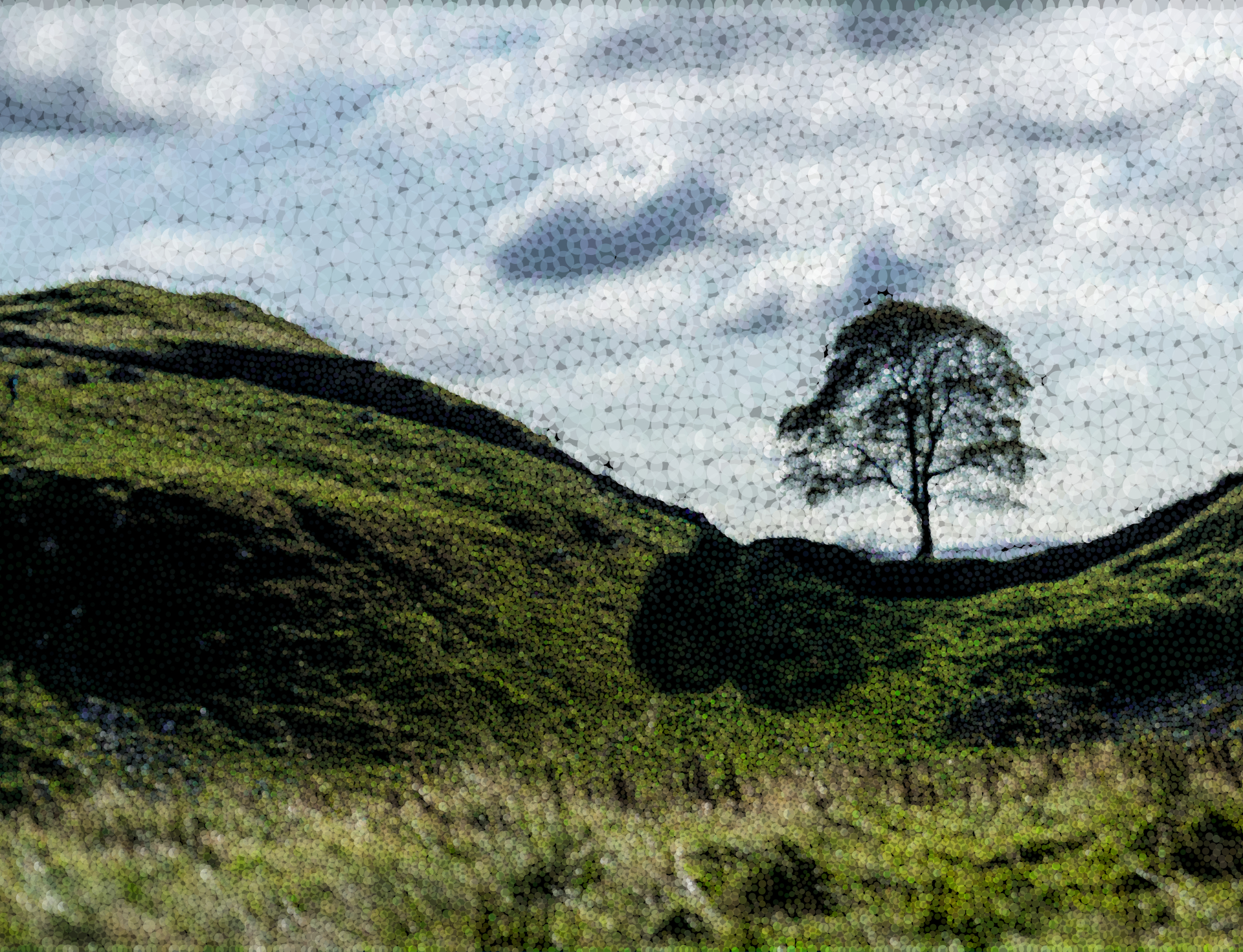
I remember that incident! As a side-effect I discovered that beautiful panorama picture[0], which was perfect for my two-monitors-plus-laptop-screen set-up aside from the low resolution, so I used my stippling notebook[1] to hide that a little bit[2]. I could probably tweak the stippling settings a bit to have prettier output, but it's been my wallpaper for over two years now.
[0] https://upload.wikimedia.org/wikipedia/commons/5/56/Sycamore...
[1] https://observablehq.com/@jobleonard/a-fast-colored-stipple-...
[2] https://blindedcyclops.neocities.org/sycamore_gap_tree_pano/... https://blindedcyclops.neocities.org/sycamore_gap_tree_pano/... https://blindedcyclops.neocities.org/sycamore_gap_tree_pano/...
One tree I'm surprised not to see here - the tree that Newton sat under that supposedly hit him on the head with an apple.
I'm sure everybody could name local examples of Trees of Mild Renown.
Mine is the Jollyman Oak, which stood in Jollyman Park on Stelling Road, Cupertino and was 160 years old before residential re-development crushed its root system.
I heard about its death via Facebook.
Glad to see the Major Oak on there https://en.wikipedia.org/wiki/Major_Oak
Lots of school trips to see a wonky tree were had as a child!
I clicked expecting some catalog of data structures but it was a pleasant surprise.
Includes Martin Fowler's strangler fig. Yes it is a design pattern and a tree.
There are surely more trees than this
If I haven't seen them, then they don't exist.
Slightly off topic but does anyone know where to get a huge dataset of tree images? I'm talking millions.
Interesting to me how many of the European examples are yews and oaks.
And here I was excited to see disjoint subtrees of Wikipedia's articles.
Of course: https://m.xkcd.com/2977/
I was unreasonably excited they included Pando.
Why is Pippi Longstocking's "soda pop tree" not on the list? It's dying and the whole of Sweden are freaking out. We're putting tax payer money on solving its disease. We're developing a vaccine to try and save it for gods sake. Yes, this is a very LOL type of situation to the rest of the world, I know that. But it's not a laughing matter in Sweden: https://www.slu.se/nyheter/2025/11/pippis-sockerdrickstrad-r...
Does the tree have a Wikipedia article about it? If not you can add it. If it does, you can add it to the list.
Wikipedia allows anyone to edit and contribute! (although many users don't know that and a smaller than miniscule amount of users actually do.)
This is why Wikipedia is great.
I asked ChatGPT to infer some facts from this list and it hallucinated an entire tree.
Is this list comprehensive?
Not even remotely.
Take the following link which is part of an Defra (UK gov) funded initiative called 'Trees Outside of Woodlands' and constitutes a public map showing lone trees, groups of trees and small woodlands across England.
https://ncea.maps.arcgis.com/apps/instant/sidebar/index.html...
How could it be? Growing up, there was a large horse chestnut tree that was a meeting point for all the kids in the neighborhood. It was such a huge part of our lives that it became an icon for our childhood, as several others have agreed with me as adults. It's gone now, as it grew old and diseased and someone cut it down. But it was a very significant tree for many people in the town for many years. I doubt, however, that it, or so many other trees that had similar impact on people, would ever make a Wikipedia list. There are just too many trees.
No, but you can add anything missing if you have a source!
It can never be. There are many notable trees, but some of them will never have a Wikipedia article.
It would be interesting to see the list of past trees. The most famous I can think of Donar's Oak (also called Thor's Oak), which was revered by Germanic pagans, and felled by Saint Boniface.
Nice! Includes Mythological and religious trees!
In the heart of Silicon Valley, El Palo Alto: https://en.wikipedia.org/wiki/El_Palo_Alto
The saddest part of this is that we really have no idea just how many or the oldest redwood trees that were felled in California and on the western cost of the USA that were possibly multiple thousands of years old, i.e., 4000 years, possibly even 6000 years based on old images and accounts of trees, and that's just what we do have signals about.
Side note; there are several places in Europe where Sequoias were planted at various times and are basically infants at 150-200 years old, having been brought back to Europe by explorers and aristocrats.
And in contrast to that, have a look at home many trees we are losing every year:
https://ourworldindata.org/deforestation
some of which could have made it to this list of special trees :-(